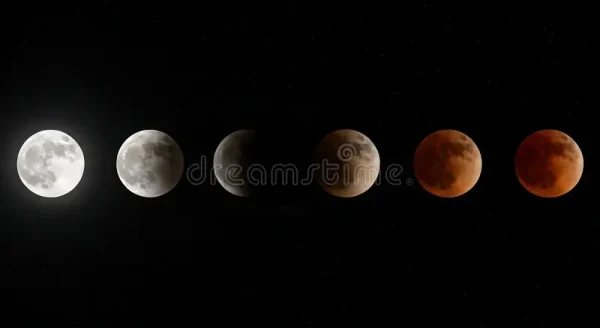



































A lunar eclipse happens when the Earth passes directly between the Sun and the Moon. This causes the earth’s shadow or the umbra to cover the moon completely. When all three planets are in a straight line in the order of the Sun, Earth and Moon it is known as syzygy. Though the Earth blocks light from the Sun, the Moon still has light that reaches it. The sunlight must go through the Earth, which scatters shorter wavelengths like blue and green, to get to the Moon. While this occurs, it allows for longer wavelengths such as red and orange to pass through. The refracted light created illuminates the Moon, which gives it a copper or red glow also known as a Blood Moon. The eclipse goes through phases with the first one being a penumbral lunar eclipse. This transpires when the Moon moves through the outer part of the Earth’s shadow or the faint. Not being as exciting as the other lunar eclipses it is sometimes mistaken for a full Moon. This is because the penumbra is a lot fainter than the dark core of the Earth’s shadow.
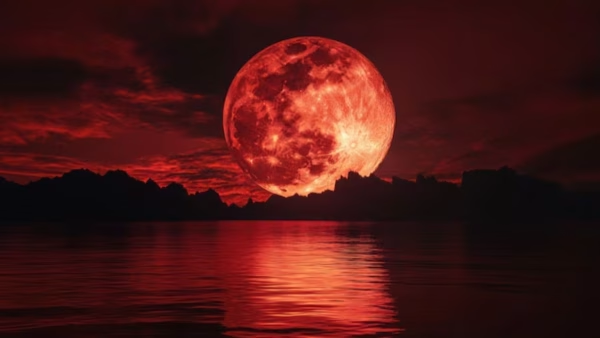
The next eclipse phase is the partial eclipse, where the Moon starts to enter the umbra, and a portion of it darkens noticeably. For this to happen there must be a full Moon and the Sun, Earth and Moon must be aligned in an almost straight line. The full eclipse can last from 30 minutes all the way to two hours. This is where you see the full Moon with a reddish, orange color, giving the name “blood moon”. In the last phases, the Moon slowly exits the Earths umbra, ending the eclipse. This scientific phenomenon is very important as it gives a chance to expand and understand things in astronomy.
These eclipses have helped humans historically figure out strange features of the earth. Eclipses helped us determine that the Earth was not flat, as philosophers in Ancient Greece noticed the Earth’s shadow on the Moon was always curved when an eclipse occurred. During the totality of the eclipse the Moons color is dependent on the air quality when the sun passes through. This can give a deeper insight into the Earth’s atmosphere.